

Beyond R&D: Manufacturers as Partners Enabling Access to Rare Disease Care

Summary
In this fifth and final article of our APAC rare disease series, we explore key opportunities for manufacturers to strengthen rare disease healthcare system readiness through multi-stakeholder collaboration.As part of a pro bono disease initiative exploring how multi-stakeholder collaboration can advance care for people living with rare diseases in Asia-Pacific (APAC), we are soliciting the views of patient groups, payers, clinicians and industry leaders. Complete this survey to share your perspective.
Patients’ ability to access rare disease care is limited by not only clinical innovation, but by the healthcare system’s readiness to identify patients, evaluate evidence, fund innovative therapies, and deliver coordinated care. Manufacturers have the resources, technical expertise, and evidence-generation capabilities to change this. Specifically, they can play a broader role beyond drug development by partnering with stakeholders to co-develop and co-refine solutions that improve access to care for people living with rare diseases (PLWRD).
Elevating the Patient Voice in Reimbursement Decision Making
Despite payer interest in incorporating patient perspectives, patient involvement in health technology assessment (HTA) remains inconsistent across APAC. Systemic barriers such as misalignment on what constitute relevant evidence, geographic challenges, and resource constraints limit meaningful patient participation.
In light of these barriers, manufacturers may play a complementary role by providing patient groups with technical, evidentiary, and capacity-building support where appropriate, helping to strengthen the quality and sustainability of patient engagement. This support may include co-developing data collection tools, generating patient-reported outcomes, and translating patient insights into HTA-relevant evidence formats that can be readily integrated into decision making. Such investments not only support more patient-centered decision making, but also help manufacturers demonstrate the true value of rare disease therapies to payers.
For example, a patient survey conducted by AstraZeneca and the Taiwan Cancer Foundation helped inform out-of-pocket costs, ultimately leading Taiwan’s National Health Insurance to reimburse for olaparib and bevacizumab as maintenance therapy for BRCA-mutated and/or genomically unstable advanced epithelial ovarian, fallopian tube, and primary peritoneal cancers.
Co-designing Innovative Contracts to Address Payer Concerns Around Affordability and Clinical Uncertainty
In addition to elevating the patient voice in reimbursement decision making, manufacturers can collaborate with stakeholders to co-design innovative contracts, enabling timely access for rare disease therapies that may otherwise face significant reimbursement hurdles. Grounded in a shared goal to improve patient access, innovative contracts move beyond simple discounts, enabling payers to manage affordability and clinical uncertainty while preserving incentives for manufacturers to invest in high-cost, low-volume therapies.
While still relatively new to APAC compared to Europe and the US, innovative contracts are already being implemented in the region to enable timely access to rare disease treatments. For example, in Taiwan and South Korea, an outcome-based annuity model has been implemented for onasemnogene abeparvovec, a one-time gene therapy used to treat spinal muscular atrophy.
For these innovative contracts to succeed, manufacturers and payers need to establish sustained collaboration built on mutual trust. Manufacturers should engage early with payers, be transparent about evidence gaps and uncertainties, and adopt a patient-centric approach. At the same time, innovative contracts must be tailored to local healthcare system realities (e.g., aligning data collection and payment mechanism with the country’s existing data and fiscal infrastructure) and informed by a strong understanding of the payer and patient challenges they are intended to address. As such, successful innovative contracts are co-designed across manufacturers, payers and other relevant stakeholders (e.g., providers involved in collecting outcomes data for outcomes-based agreements) to create shared value.
Stronger Together: Coordinating Industry Efforts to Improve Access to Rare Disease Treatments
Beyond reimbursement, achieving access to rare disease care also requires addressing healthcare system barriers such as fragmented care pathways, variable access to centers of excellence, and workforce and geographic constraints. Manufacturers can play a catalytic role by working with patient groups and clinical associations to surface and address gaps in care pathways. Importantly, industry associations can facilitate collaboration among competing manufacturers on shared priorities, acting as a credible, neutral bridge to non-industry stakeholders. Engagement through a collective industry body can reduce perceived commercial bias, fostering more open and constructive collaboration driving system-level change rather than individual product advocacy.
While industry associations are common in APAC, dedicated platforms for specific therapeutic areas such as rare disease are limited. Rare diseases face a distinct set of challenges that broader industry associations may not be well positioned to prioritize – orphan drugs operate under different regulatory pathways, pricing logic, and evidentiary standards than mainstream therapeutics. Yet, general industry associations are likely to prioritize issues affecting the largest share of their membership, which can inadvertently sideline specific challenges faced by orphan drug manufacturers. Dedicated rare disease industry associations are therefore important in ensuring that the unique policy, access, and reimbursement challenges of rare diseases remain visible and consistently represented.
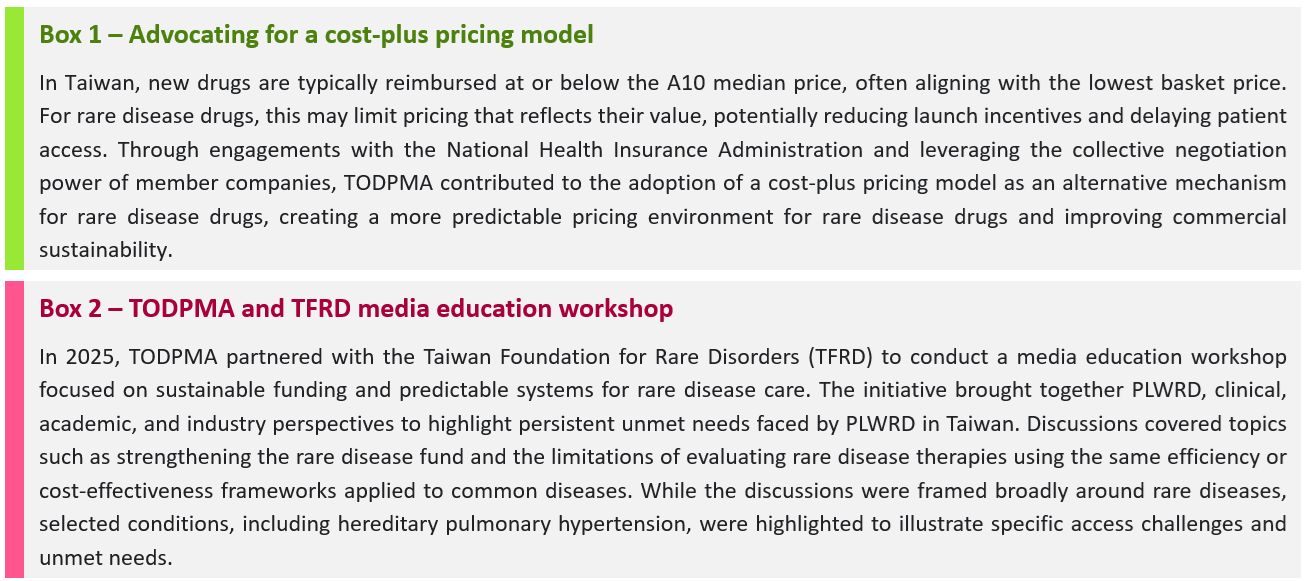
The experience of the Taiwan Orphan Drug Pharmaceutical Medical Association (TODPMA) demonstrates that collective action led by manufacturers can address system-level challenges. Although still in its early stages, TODPMA has made tangible progress in helping to shape Taiwan’s rare disease ecosystem through coordinated efforts, both by enabling more favorable pricing for rare disease drugs (Box 1), as well as by building collective rare disease advocacy with non-industry stakeholders (Box 2).
Critically, effective collaboration between manufacturers requires a careful balance. A broad “all rare diseases” framing risks diluting impact, whereas an overly narrow focus on a single condition may unintentionally marginalize others. The right balance can be achieved by anchoring advocacy in a shared rare disease agenda, while drawing on selected disease examples and patient stories to create urgency, focus attention, and guide resource prioritization.
The Way Forward: Strategic Imperatives for Manufacturers
Across APAC, the rare disease access landscape is gradually being reshaped by a more mature understanding of the problem: Access fails when stakeholders act independently, but it improves when they align around shared “system readiness.” This is resulting in a shift from lower levels of engagement (e.g., inform and consult) to higher levels of engagement (e.g., co-design and co-refine).
Looking ahead, the APAC rare disease ecosystem is expected to see the following developments:
- Evolving payer frameworks to recognize nuances in the rare disease landscape and incorporate patient voice in decision making
- Increasing stakeholder willingness to co-design innovative access solutions
- Growing need for investment in diagnostic infrastructure, specialist capacity, and allied health roles so that funded therapies can translate into outcomes
Together, collaborative efforts between stakeholder groups – still uneven but clearly advancing – will shape the rare disease momentum across the region and present opportunities for manufacturers to engage in innovative ways to improve access and outcomes for patients. Realizing this potential will require manufacturers to move beyond asset-specific priorities and align on common priorities across stakeholder groups, actively contributing to co-design efforts spanning both policy and implementation, and mobilizing cross-functional collaboration to support system readiness for the future of rare disease care.
This is the fifth and final installment of our APAC rare disease series, exploring how multi-stakeholder collaboration can advance care for PLWRD. Explore our other articles below:
- Levels of multi-stakeholder collaboration: a framework
- Patient group perspective
- Payer and HTA expert perspective
- Clinician perspective
Play a role in the APAC rare disease space? Share your perspectives via a short survey.
Services
produces measurable results. Let's work together.


