

From Concept to Practice: Driving Collaboration in Rare Diseases Across Asia-Pacific

Summary
In this first installment of our APAC rare disease series, we introduce the topic of multi-stakeholder collaboration and present a corresponding framework.Why Collaboration Matters in Rare Disease
Patients with rare diseases are too often overlooked and underserved. Asia-Pacific (APAC) is home to more than 258 million persons living with rare disease (PLWRD), yet only a third in the region receives the best available evidence-based care.
To foster more equitable and timely access to rare disease care, the World Health Assembly Resolution on Rare Diseases, adopted in May 2025, calls on the World Health Organization to develop a 10-year Global Action Plan for rare diseases. The plan would provide a strategic and coordinated framework to address global health challenges through collaboration among countries, non-governmental organizations, clinicians, manufacturers and other key stakeholders.
Multi-stakeholder collaboration enables better access to therapies for PLWRD. Rare disease is a therapeutic area for which evidence is limited, patients are often scattered, and their needs are often unmet, making collaboration all the more critical to pool expertise, data, and resources to drive meaningful progress. While stakeholders have a genuine desire to collaborate, they may struggle to navigate complex operational challenges, from reconciling differing objectives to coordinating responsibilities across diverse groups.
Our Rare Disease Initiative
In a new series of insight articles, Avalere Health is bringing together diverse perspectives from patient groups, payers, clinicians, researchers, and industry representatives across APAC to explore how successful collaboration can be operationalized to advance care for PLWRD. Critically, we move beyond the long-standing conversation of why collaboration matters, to focus on how effective collaboration can be operationalized in APAC. We will explore cross-country learnings and highlight the current state of collaboration, aspirations for the future, and the key factors for success.
This first installment of the series introduces a framework outlining the various levels of collaboration, offering a structured way to understand how different stakeholders can work together effectively.
We also invite you to be part of our initiative – share your views on the future of multi-stakeholder collaboration in rare disease care by completing this survey.
Collaboration Exists Along a Continuum
Collaboration can be fostered at different levels, with stakeholders engaged to different extents of their capabilities and expertise (Figure 1). At the highest levels of collaboration, responsibility is more equally shared, with stakeholders contributing comparable effort, resources, and decision-making power.
Each level of collaboration offers distinct advantages and trade-offs, with the best approach shaped by context, decision urgency, and resources. Lower levels may be more effective for rapid decision-making, while higher levels may be more suited when building consensus, addressing issues with broad societal impact, or fostering long-term commitment. Remaining dynamic and flexible is therefore essential.
Figure 1: Levels of Collaboration and Illustrative Examples
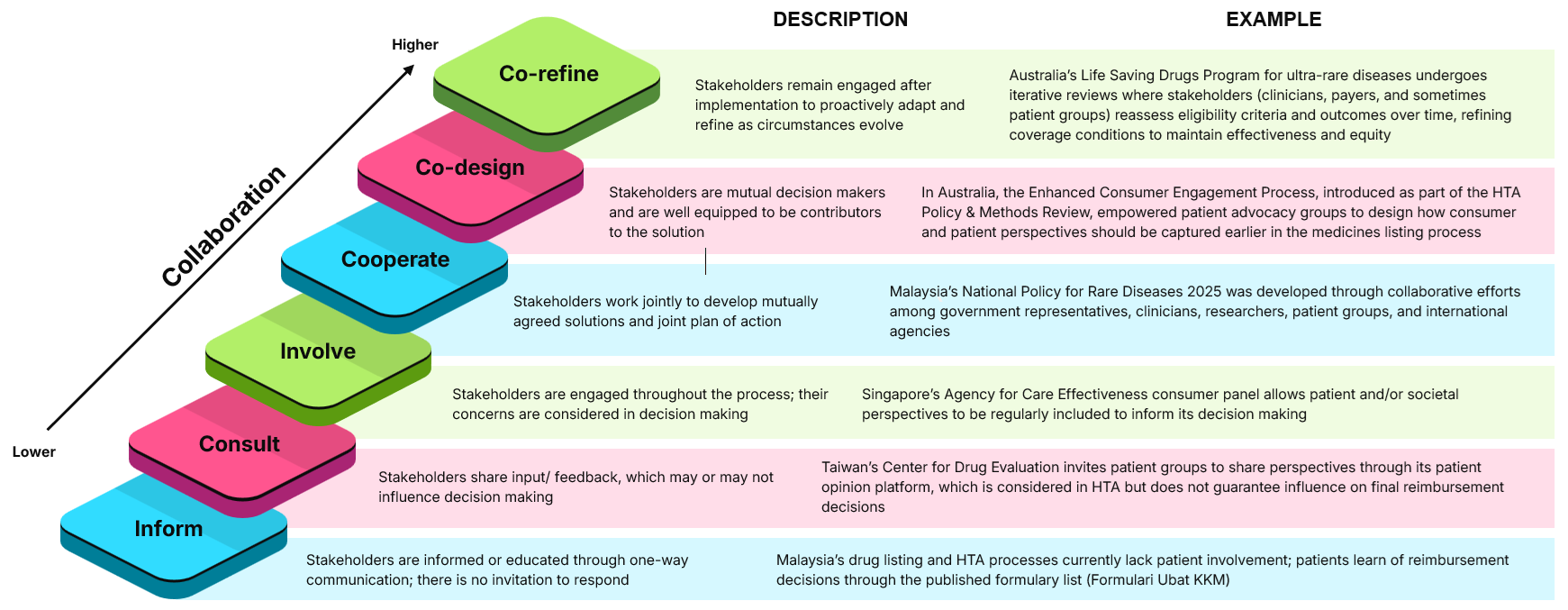 Adapted from the Australian Department of Health, Disability and Ageing. HTA: Health Technology Assessment
Sources: Australia’s Life Saving Drugs Program, Australia’s Enhanced Consumer Engagement Process, Malaysia’s National Policy for Rare Diseases 2025, Singapore Agency for Care Effectiveness’ consumer panel, Taiwan Center for Drug Evaluation’s patient opinion platform, Malaysia’s drug listing and HTA processes
Lessons from Stakeholders Across APAC Rare Disease Care
Over the coming months, our Insight series will distill learnings from patient advocacy groups, payers, clinicians, researchers, and industry. We will explore:
- Their current and evolving roles in the rare disease ecosystem
- Key learnings from their past experiences in multi-stakeholder collaboration
- What it takes to advance to higher levels of collaboration when needed
- Their vision for future collaboration with other stakeholders
Drawing from these insights, we aim to provide a practical roadmap for operationalizing multi-stakeholder collaboration in rare disease care. By capturing cross-country lessons from different stakeholders across APAC, the series highlights best practices and innovative approaches that may be adapted across different contexts. The goal is to inspire and empower stakeholders to work together more effectively, accelerating access to rare disease therapies and improving outcomes to make EVERY PATIENT POSSIBLE.
We invite you to share your views on the future of multi-stakeholder collaboration in rare disease care by completing this survey.
~
This is the first installment of our APAC rare disease series, exploring how multi-stakeholder collaboration can advance care for PLWRD. Explore our other articles below:
Services
produces measurable results. Let's work together.


