Medicaid Work Requirements: Understanding Exemptions and Protecting Patients

Summary
Medicaid work requirements are expected to start January 2027, with narrower exemptions than anticipated. Learn how life sciences companies, plans, and providers can support patients.Background on the Proposed Rule
On June 1, the Centers for Medicare and Medicaid Services (CMS) released an interim final rule with comment period (IFC) on work requirements (which it calls “community engagement requirements”) for most Medicaid enrollees. The comment period remains open through July 31, 2026, with requirements expected to take effect January 1, 2027.
Applicable individuals must demonstrate 80 hours per month of qualifying activities, which include employment, participation in work programs or community service, and at least part-time enrollment in education.
For certain new applicants, requirements must be met for at least one month prior to the month of application. Existing enrollees must meet the requirement for one or more months between renewals.
Based on the One Big Beautiful Bill Act, which underpins the IFC, the Congressional Budget Office has estimated that 7.8 million Americans could become uninsured under these expanded definitions by 2034, making it critical for stakeholders to understand where their patient populations fall on the eligibility spectrum and take targeted action.
Who is Subject to Work Requirements?
A small group of states already have Medicaid work requirements, but the IFC introduces nationwide requirements for most non-pregnant, working-age adults enrolled in the program, with nine exempt groups. The exemption for “medically frail” individuals is narrower than anticipated: having a serious or complex medical condition alone is not sufficient for exemption. The condition must also impair at least one activity of daily living (ADL), such as mobility, bathing, dressing, toileting, continence, or eating.
The likelihood that an individual with a serious or complex medical condition will be affected by the work requirement will vary depending on the nature and acuity of their specific health condition(s). Healthcare stakeholders, including plans, providers, and life sciences companies, should consider how the patients that they currently serve could be impacted—either by losing coverage or facing disruptions in coverage and treatment.
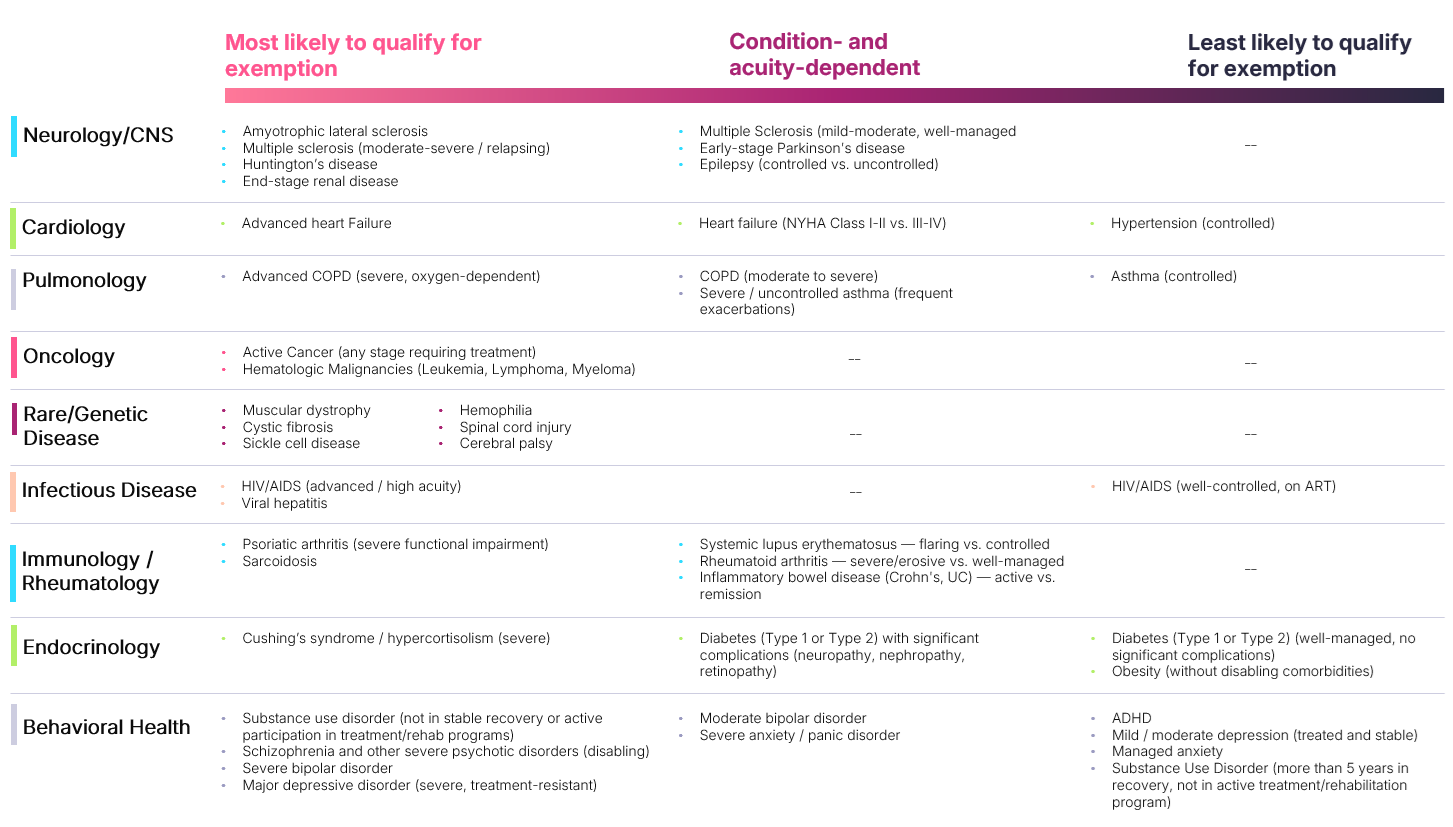
To support this work, Avalere Health experts have identified where conditions in key therapeutic areas are likely to fall in the spectrum from most to least likely to qualify for an exemption.
Figure 1. Mapping Conditions to Work Requirements
What Stakeholders Can Do Now
Life science companies, health plans, providers and hospitals have distinct roles to play in reaching EVERY PATIENT POSSIBLE and minimizing disenrollment, particularly among patients with serious or complex medical conditions. Much of this comes down to ensuring that patients are aware of the new requirements and are able to navigate the new enrollment processes.
We’ve outlined some opportunities for each stakeholder:
Life Sciences Companies
- Develop above-brand provider and patient communications on exemption processes and documentation requirements, particularly around ADL impairments
- Generate and disseminate real-world evidence on functional impairment across relevant therapeutic areas to support exemption documentation
- Enhance patient support programs to include work requirement navigation assistance, including connecting patients with opportunities that would qualify to meet work requirement obligations
- Partner with advocacy organizations to educate patients on their rights and exemption pathways
- Streamline patient assistance programs to reduce coverage gaps for patients who lose Medicaid coverage due to procedural disenrollment
Health Plans
- Develop provider-facing tools, templates, and education to support accurate, compliant documentation of ADL impairments aligned with state verification requirements
- Partner with community-based organizations (CBOs) to connect members with resources to meet work requirement obligations
- Launch targeted member education campaigns tailored to support member awareness of work requirements
Providers and Hospitals
- Integrate ADL assessment and functional status documentation into routine clinical workflows, particularly for gray zone conditions
- Train clinical staff on the specific ADL impairment standards required under the IFC to ensure documentation supports exemption determinations
- Screen for social determinants of health to connect patients with employment, education, and community engagement resources that satisfy work requirements
- Coordinate with health plans and CBOs to ensure continuity of care for patients at risk of losing coverage
- Develop rapid-response pathways for medical records and other documentation requests for patients needing to demonstrate compliance or exemption to avoid disenrollment
Collaborate with an Expert Advisory Team
With the January 2027 implementation deadline fast approaching, the difference between patients retaining or losing Medicaid coverage may come down to accurate condition documentation, clearly captured functional limitations, and access to support in navigating a complex, new verification process. Life sciences companies, health plans, and providers each have a distinct and critical role to play across the full therapeutic area spectrum. Whether your organization is assessing population-level risk, building documentation support tools, or developing a cross-stakeholder engagement strategy ahead of January 2027, Avalere Health has the expertise to help you move forward with confidence. Connect with us today.
Read our other work requirement analyses:
Services
produces measurable results. Let's work together.