Post-Clover and 2027 QBP Re-Calculation: What Could Be Next for MA Stars?

Summary
CMS will be re-calculating 2027 QBP ratings following the May 2026 Clover ruling. Avalere Health experts share insights on potential future directions for the MA Star Rating program.On June 17, the Centers for Medicare and Medicaid Services (CMS) released a Health Plan Management System (HPMS) memo announcing that it will recalculate 2027 quality bonus payment (QBP) ratings for Medicare Advantage (MA) plans in light of the May 2026 Clover vs. U.S. Department of Health and Human Services, et al. ruling (Clover ruling).
In the HPMS memo, CMS outlined that it will recalculate MA Star Ratings for 2027 QBP ratings using only the data authorized for collection under 42 U.S.C. 1395w-22(e) as of November 1, 2003, which is essentially Consumer Assessment of Healthcare Providers and Systems (CAHPS), Healthcare Effectiveness Data and Information Set (HEDIS), and Health Outcomes Survey (HOS) data. This will remove all Part D measures as well as six Part C (MA) measures. CMS will assign either the original or newly calculated Star Rating—whichever is higher—for 2027 QBP ratings.
CMS specified that it is only making these changes for 2027 QBP ratings, not to 2027 MA Star Ratings/2028 QBPs. This announcement has major implications, but leaves a number of unanswered questions related to the future of MA Star Ratings. Below, Avalere Health experts explore the future of the MA Star Ratings program in the wake of the Clover ruling.
What’s the Status of CMS’s Data Collection Authority?
The Clover ruling hinges on CMS’s data collection authority granted under 42 CFR § 1395w-23(o)(4)(a). This regulation established the five-Star system based on data collected under 42 CFR § 1395w-22(e), which requires MA organizations (MAOs) to have ongoing quality improvement programs. As part of those programs, MAOs must collect, analyze, and report data that “permits the measurement of health outcomes and other indices of quality.” These measures are namely Part C HEDIS, HOS, and CAHPS.
In the Clover case, a federal court concluded that CMS can only base quality rating calculations on measures that use data collected under 42 CFR § 1395w-22(e). Therefore, if the Clover ruling is not appealed and then overturned, CMS will need to either:
- Change the measures used in the Star Ratings program; or
- Request that Congress grant the agency authority over additional datasets.
How Quickly Can CMS Make Major Changes to the Stars Program?
The recent court decision and its Star Ratings implications are complicated, but the regulation is seemingly straightforward. 42 CFR § 422.164 and 42 CFR § 423.184 specify that substantive changes to Star Ratings must go through notice-and-comment rulemaking. The Administrative Procedure Act requires the same.
While many stakeholders are focused on the scope of the Clover ruling, it is important to acknowledge that the regulation provided some degree of predictability. The court enforced the regulations as written. The June memo was carefully structured to communicate that only QBPs would be re-calculated, not Star Ratings. CMS can correct payment errors without rulemaking, but it cannot change the underlying ratings methodology without going through the Notice of Proposed Rulemaking (NPRM) process.
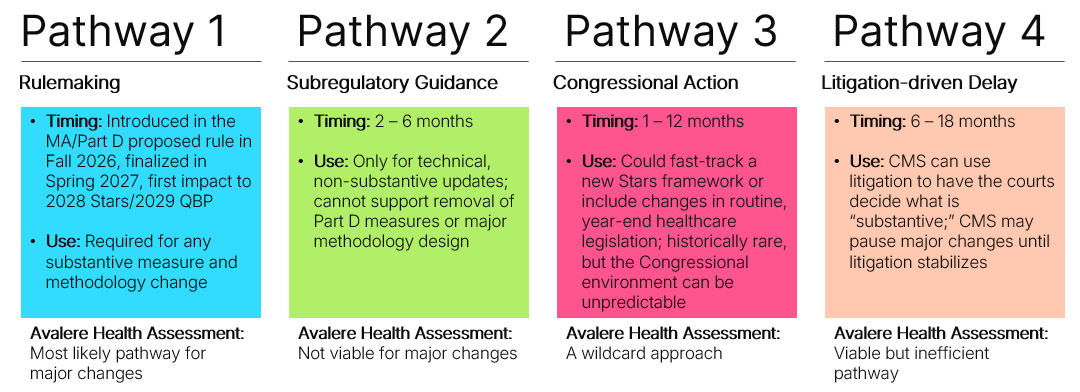
We have identified potential scenarios through which CMS could make program changes (Figure 1).
Figure 1. Four potential pathways CMS could take to make changes to MA Stars
What Can CMS Do Immediately?
CMS may pursue near-term solutions as it develops its longer-term strategy. One near-term solution, for 2027 is to take a dual-track approach to QBPs (Figure 2). This may be adopted in future years
Figure 2. Hypothetical Dual-Track Approach
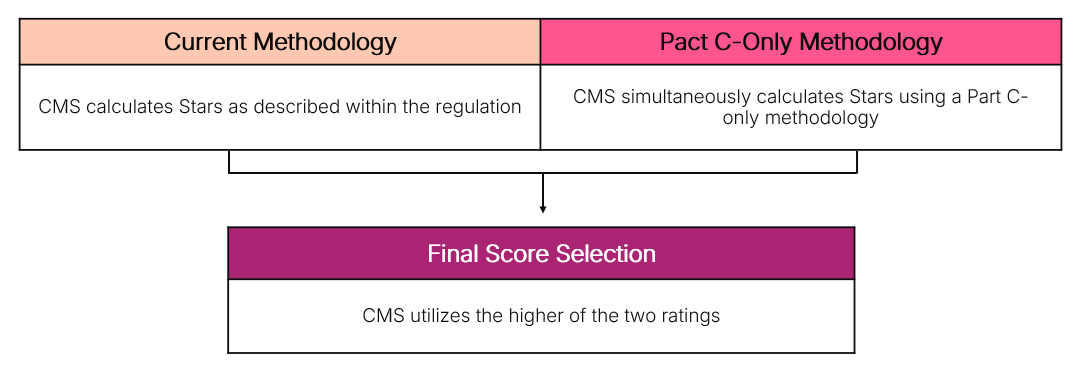
This arguably would not change the methodology, but it would change how to apply ratings for payment purposes. Utilizing the higher of the two ratings could potentially stabilize payments and mitigate litigation risks, thereby allowing time for rulemaking. Operationally, this pathway would be the least disruptive.
Other pathways include the issuance of subregulatory guidance, but this is unlikely because the regulations clearly limits this action to non-substantive changes. Congress could also intervene, but historically has not legislated Star Ratings and has not had bipartisan consensus on MA payment levels.
Looking Ahead
It remains to be seen what the future of the MA Star Ratings program will look like. We anticipate that CMS will provide more guidance either through stand-alone rules or, more likely, as part of the 2028 Part C and Part D rule, expected in the fall.
Avalere Health’s Medicare Advantage experts are well equipped to help health plans model out potential scenarios, adjust MA Star strategies and operations, and engage CMS in shaping the future of the program. Connect with us
Services
produces measurable results. Let's work together.