Patients are Ready for Radioligand Therapy, But is Our Healthcare System?

Summary
Radioligand therapies show benefit across cancers, but US adoption is limited by infrastructure, reimbursement, imaging access, and care coordination gapsRadioligand therapies (RLTs) are emerging as a transformative precision therapy across multiple oncology indications, including prostate cancer, neuroendocrine tumors, thyroid cancer, and certain brain tumors. They are also key components of an expanding pipeline of targets in breast, lung, and hematologic malignancies.
Demonstrated Benefits of RLTs
RLTs have shown compelling clinical benefit and tolerability in Food and Drug Administration-approved and late-phase trials. In advanced prostate cancer, for example, RLTs significantly improve survival outcomes, delaying disease progression and extending overall survival, while maintaining a favorable safety profile. Patients also report delayed deterioration in health-related quality of life (QoL) and pain.
For patients with neuroendocrine tumors, long-term data indicates that RLTs can effectively stabilize disease progression and deliver sustained symptom relief, with limited hematologic and renal toxicity and a durable benefit in progression-free survival. Clinical trials and real-world evidence across indications have demonstrated that RLTs can offer not only meaningful disease control but preserve or improve QoL, with a safety profile that is often favorable to traditional systemic therapies.
Is the Healthcare System Ready for RLTs?
Despite the efficacy and safety of RLTs, the US healthcare system faces substantial infrastructure barriers to its delivery. Dedicated treatment suites remain in short supply, with many existing centers lacking sufficient capacity and trained staff. There are also several challenges associated with establishing or scaling RLT suites, including financial burden, complex radiation-safety requirements, lack of nuclear medicine specialists, and training needs.
While industry investment in domestic isotope production, supply-chain expansion, and clinical workforce training continues to grow, access remains uneven, disproportionately affecting rural and community-based care settings. Such disparities exacerbate health equity gaps, especially given that some of the most promising RLT indications (like prostate cancer) are common in underserved patient groups.
These issues are compounded by other factors such as underutilization of radio-diagnostic scans, limited referral patterns, positioning in clinical guidelines, and a complex reimbursement landscape shaped by diverse payer policies. For example, many guidelines require specific Positron Emission Tomography (PET)-based molecular imaging (e.g., prostate-specific membrane antigens PET or somatostatin-receptor PET) to confirm RLT-eligibility, yet these tests are less available in community and rural settings, and are often not considered by specialties less familiar with nuclear medicine. Reimbursement complexities for radiodiagnostic scans pose additional barriers and can deter ordering clinicians. In parallel, multidisciplinary team collaboration and referral to nuclear medicine specialists remains inconsistent, creating further barriers to this potentially life-changing modality. Finally, many centers lack billing and coding experience in RLT reimbursement, leading to delays, administrative burden, missed opportunities for timely therapy initiation, and poor first experiences.
Addressing these gaps in infrastructure, reimbursement readiness, and coordinated care pathways will be essential for the US healthcare system to realize the full potential of RLT and extend its benefits equitably across patient populations.
Next Steps
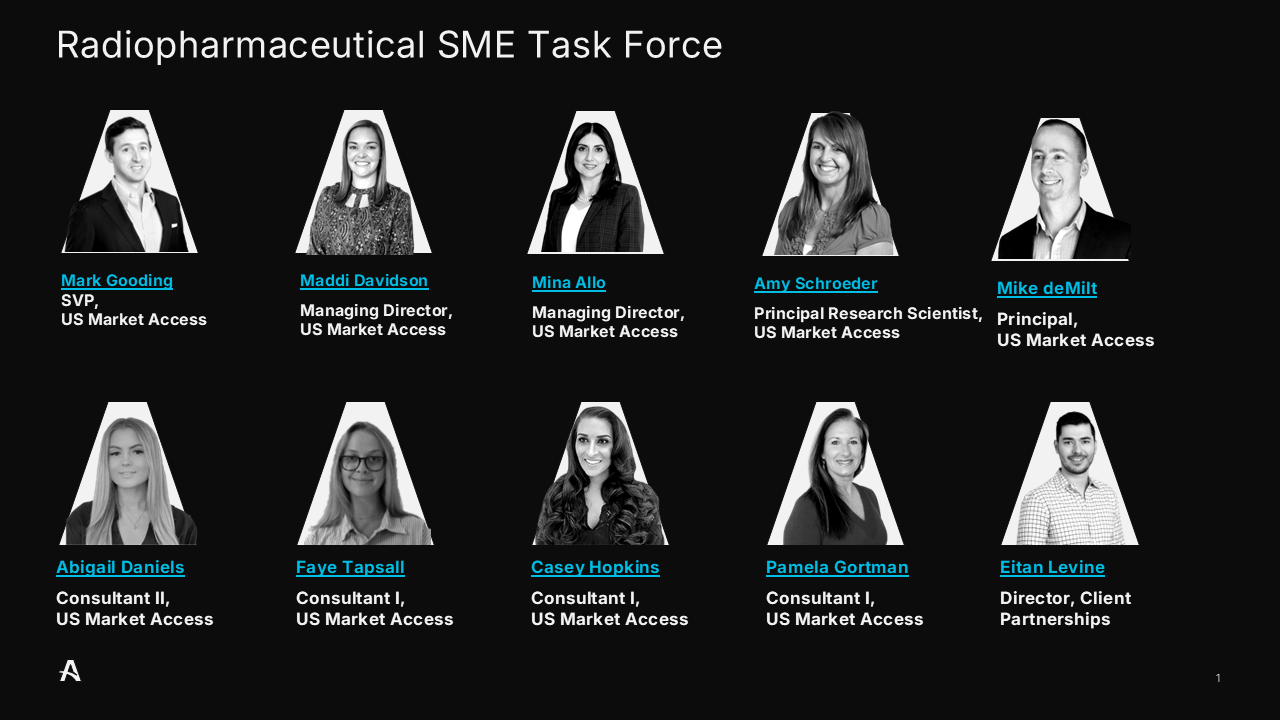
Avalere Health subject matter experts help payers, providers, and manufacturers navigate the evolving RLT landscape, addressing barriers in infrastructure, reimbursement, and care coordination to improve access. Connect with us to learn how these factors are shaping RLT adoption and patient outcomes.
This article is part of the Radioligand Therapy: A Future within Reach series exploring the evolving RLT landscape and strategies to advance access and readiness. Keep an eye out for our next insight, Everything We’ve Learned from the RLTs on the Market.
Services
produces measurable results. Let's work together.