New Analysis Highlights Opportunities to Improve MPPP Uptake

Summary
Avalere Health’s latest analysis found very low uptake of the Medicare Prescription Payment Plan (MPPP) in 2025, even among those who could benefit most.Following the first year of implementation of the Inflation Reduction Act’s (IRA) redesigned Part D benefit, Avalere Health analyzed 2025 Medicare Part D claims to examine beneficiary out-of-pocket (OOP) spending patterns and enrollment in the MPPP during the first year of implementation. The analysis found that most beneficiaries in the study population (defined as beneficiaries not receiving the low-income subsidy and not enrolled in Employer Group Waiver Plans) had relatively low annual OOP spending, with nearly 72% (more than 22.7 million beneficiaries) spending less than $120 total OOP in 2025. However, even among the remaining beneficiaries with higher OOP exposure who could benefit from the MPPP, enrollment in the program was very limited. Overall, just 1% of beneficiaries (approximately 333,000) in the entire study population enrolled in the MPPP in 2025.
Enrollment in the MPPP Is Very Low Even Among Those with High OOP Costs
Because the MPPP is intended to help beneficiaries who face high OOP costs manage their expenses over the course of the plan year, Avalere Health examined enrollment in the MPPP among two cohorts of beneficiaries with higher OOP spending:
- Beneficiaries who reached the catastrophic phase of the Part D benefit, or
- Beneficiaries who had moderately high annual OOP spending without reaching the catastrophic phase
The findings show limited participation in the MPPP (Figure 1), even among beneficiaries with the greatest exposure to high OOP costs.
Figure 1. Distribution of Study Population Enrollees by OOP Costs and MPPP Enrollment, 2025
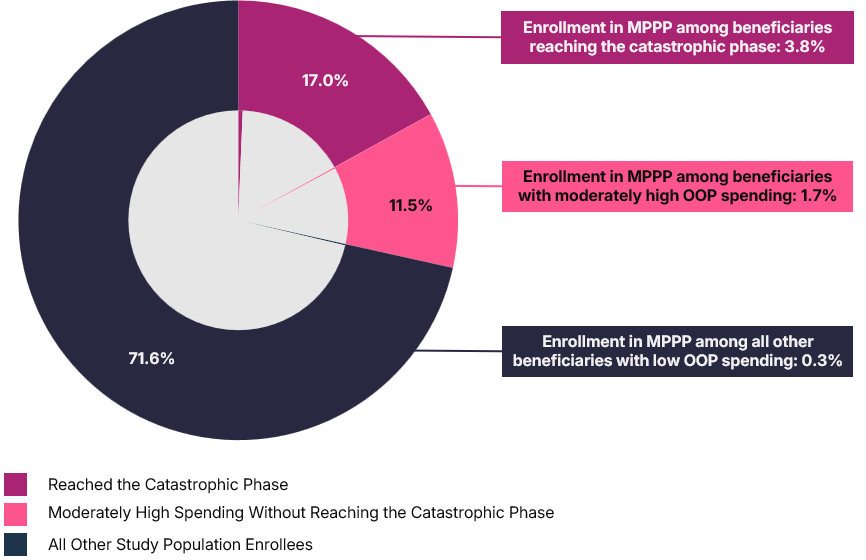
Overall, 17% of the study population (about 5.4 million beneficiaries) reached the catastrophic phase in 2025, with average annual OOP costs of $1,182. Among this cohort, only 3.8% (about 205,000) enrolled in the MPPP, representing just 0.6% of the full study population. Another 11.5% of enrollees (over 3.6 million beneficiaries) had moderately high OOP costs in 2025 without hitting the catastrophic phase; these beneficiaries had average annual OOP costs of $965. Only 1.7% (about 63,000) of this cohort (representing only 0.2% of the study population) enrolled in the MPPP in 2025.
Several Program Design Features May Contribute to Limited Participation
Lack of beneficiary awareness and understanding may have driven low enrollment in the program’s first year. However, several other MPPP design features likely also contributed to limited uptake even among beneficiaries in the study population with high OOP costs. Without program changes, these design features may continue to impact participation in the future.
- Active opt-in enrollment: Enrollment in the MPPP is not automatic, regardless of whether a beneficiary’s previous drug spending patterns indicate that they would likely benefit from the program. Beneficiaries must actively opt into the MPPP in the first year they want to participate. If a beneficiary switches to a plan offered by a different Part D sponsor, they must re-elect into the program, even when prior-year utilization patterns suggest they are highly likely to benefit.
- No point-of-sale enrollment option: Although pharmacists may notify beneficiaries filling a high-cost prescription that they could benefit from the MPPP, currently beneficiaries cannot enroll in the program at the pharmacy counter. Instead, they must separately contact their Part D plan to enroll in the MPPP before it can be applied to their prescriptions.
- Potential for variable monthly payments: The MPPP monthly payment methodology recalculates a beneficiary’s payments for the year based on their remaining OOP liability and the number of months left in the plan year. As a beneficiary fills additional prescriptions, monthly payment amounts may increase or decrease, making future costs difficult to anticipate. In some cases, these costs may fluctuate significantly from month to month, causing confusion for beneficiaries.
Opportunities to Improve Enrollment Among Those Most Likely to Benefit
Avalere Health also identified specific groups of enrollees with high OOP costs who were most likely to benefit from the MPPP but still had low enrollment in the program (Table 1), highlighting opportunities for targeted outreach and enrollment. These groups include beneficiaries with high OOP costs concentrated early in the year who could benefit from spreading these expenses over multiple months, and beneficiaries with consistently high spending to reach the catastrophic phase across several years who could be proactively identified as good candidates for MPPP enrollment.
Table 1. Beneficiary Spending and Enrollment in the MPPP, 2025
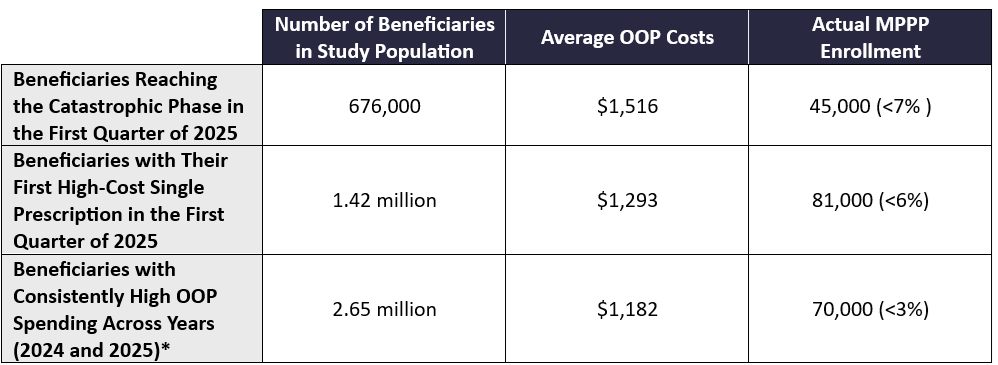
*Because the lower OOP cap was not implemented until 2025, the dollar amount to reach the catastrophic phase is not directly comparable across 2024 and 2025. The analysis included beneficiaries who had annual OOP costs of ≥$1,182 in 2024 (which reflects the average OOP spending among beneficiaries who reached catastrophic in 2025), and who also reached the catastrophic phase in 2025. For simplicity, the $1,182 value reflects the 2024 threshold for the analysis and the reported average OOP costs among the study population reaching the catastrophic phase in 2025.
Note: Numbers in table are rounded to the nearest thousand for numbers under 1 million and to the nearest ten thousand for numbers over 1 million.
The first year of the MPPP highlights opportunities to increase enrollment among those who may benefit most from the program. As policymakers continue to focus on improving patient affordability in Medicare Part D and beyond, they should consider whether modifications to the MPPP and its implementation by CMS or Congress could better support the intended goals of the program.
To learn more about how the IRA is reshaping Part D drug spending, utilization, and enrollment patterns, connect with us.
Funding provided by the Pharmaceutical Research Manufacturers of America (PhRMA). Avalere Health retained full editorial control.
Methodology
This analysis utilized Medicare data through an agreement with CMS, wherein Avalere Health has access to CMS’s Chronic Condition Warehouse Virtual Research Data Center (“VRDC Data”). In contrast to Avalere Health’s prior analysis on early MPPP enrollment, this study population excludes beneficiaries receiving the low-income subsidy (LIS) and beneficiaries enrolled in Employer Group Waiver Plan (EGWPs) because they generally have limited or no cost sharing. Beneficiary counts therefore differ between these two analyses due to differences in the beneficiary populations and timeframes assessed.
Beneficiaries who reached the catastrophic phase were identified based on their plan true OOP (TrOOP) accumulation, indicated by a positive “Gross Drug Costs Above Catastrophic” variable in the Prescription Drug Event data. Based on the policy change implemented in 2025 to count reductions in cost sharing provided by enhanced plans and EGWPs towards beneficiary OOP costs, average OOP costs to reach the catastrophic phase across beneficiaries were lower than $2,000 in 2025, on average, and vary by plan type. Beneficiaries were classified as LIS/non-LIS and EGWP/non-EGWP based on their enrollment status for the majority of months in the plan year.
Beneficiaries with “moderately high” OOP costs were identified as those who had OOP spending in the 90th percentile among all beneficiaries (including LIS and EGWP beneficiaries) who did not reach the catastrophic phase. Beneficiaries in this cohort had average OOP costs of about $571 in 2025. Table 2 and 3 include more detail on the breakdown of beneficiaries in the analysis.
Table 2: Non-LIS, Non-EGWP Enrollees (“Study Population”) with Specific Events and MPPP Enrollment in 2025
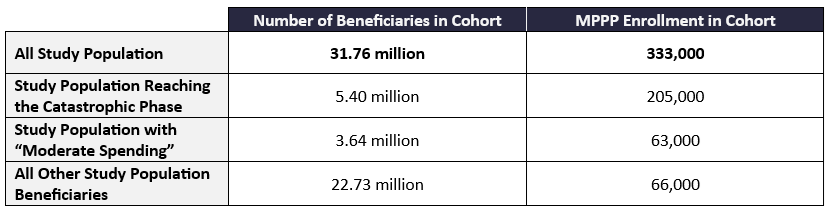
Note: Numbers in table are rounded to the nearest thousand for numbers under 1 million and to the nearest ten thousand for numbers over 1 million.
Table 3: Total MPPP Enrollment Among All Beneficiaries (Including LIS and EGWP) in 2025

Services
produces measurable results. Let's work together.