Negotiated Part B Drug Effectuation Proposals: Four SDRA Approaches and Key Tradeoffs

Summary
Stakeholders will need to weigh the tradeoffs between the various proposed standardized default refund amount methodologies.Background
Under the Medicare Drug Price Negotiation Program (MDNP), the Centers for Medicare & Medicaid Services (CMS) negotiates a maximum fair price (MFP) for selected drugs and requires manufacturers to make that price available to providers treating Medicare beneficiaries in the applicable Initial Price Applicability Year (IPAY). The process by which the manufacturer ensures that a provider can access a selected drug at the MFP is coined “effectuation”. CMS’s July 16 Draft Guidance on Manufacturer Effectuation of the MFP in 2028 under the MDNP sets forth proposed policies for manufacturer effectuation of MFPs in IPAY 2028 for selected drugs payable under Part B and/or covered under Part D.
IPAY 2028 will be the first year in which MFPs apply to selected Part B drugs. Differences in underlying data and payment flows between Part B and Part D mean that manufacturers effectuation MFPs in IPAY 2028 are contending with new complexities. In Part D, effectuation relies on the same real-time Prescription Drug Event data captured on standardized National Council for Prescription Drug Programs (NCPDP), claim format. For Part B drugs, claims and payment flows differ between Medicare Advantage and Traditional Medicare, and Part B claims are billed using Healthcare Common Procedure Coding System (HCPCS) codes rather than National Drug Code (NDC). This makes it more difficult to identify specific products administered, verify MFP eligibility, and calculate the appropriate refund amount.
Prospective vs. Retrospective Effectuation
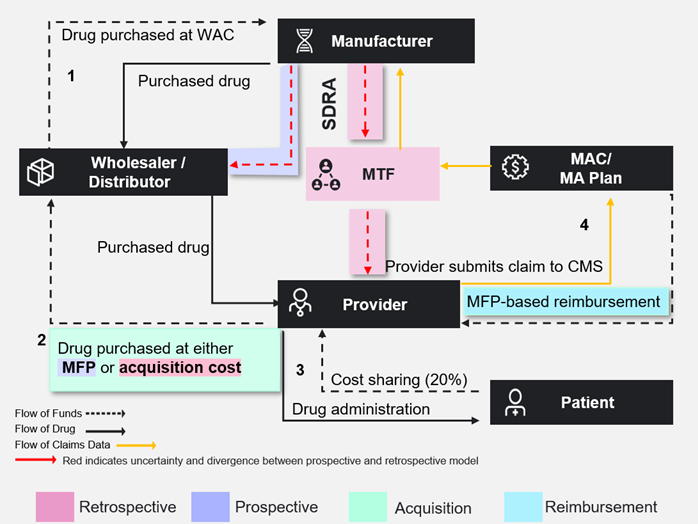
For both Part D and Part B drugs, CMS allows manufacturers to provide access to the MFP through either a prospective or retrospective approach. Under a prospective model, a provider would acquire the selected drug at a price equal to or below the MFP and receive an MFP-based reimbursement. Under a retrospective model, the provider would purchase the drug at its contracted price (which varies by provider and drug but is higher than MFP), submit a claim, and subsequently receive a manufacturer refund for the difference between the acquisition cost and the MFP. However, CMS and manufactures do not have real-time information on the price at which the provider acquired the drug, making it difficult to refund the exact difference between the MFP and the acquisition cost. To reconcile this challenge, CMS proposes using a Standardized Default Refund Amount (SDRA) as a proxy.
Graphic 1: Illustrative Example of the Effectuation
Proposed Approaches for Calculating SDRA under Retrospective Effectuation for Selected Part B Drugs
For Part D drugs selected for negotiation, CMS currently uses wholesale acquisition cost (WAC) at the NDC level to calculate the SDRA. Part B products, however, are generally billed at the HCPCS-code level and separately payable drugs are generally reimbursed at Average Sales Price (ASP) plus a 6% add-on payment (effectively lower due to sequestration). Starting in 2028, negotiated Part B products will be reimbursed at MFP + 6%, and the ASP for negotiated products will not be published.
CMS is considering four methodologies to establish SDRAs to effectuate MFP, which differ in their usage of WAC vs. ASP and their volume-weighting methodology:
- Option 1a: Average WAC weighted by ASP sales volume
- Option 1b: Published WAC for the NDC reported on the claim
- Option 2a: Average ASP weighted by ASP sales volume
- Option 2b: Average ASP weighted by Part B claims volume
Tradeoffs Between the SDRA Calculations Approaches
These approaches hinge on two key tradeoffs: whether WAC or ASP is a more appropriate proxy for provider acquisition cost and whether increased precision associated with NDC-level claims data justifies any additional administrative burden.
Overestimate vs. Underestimate
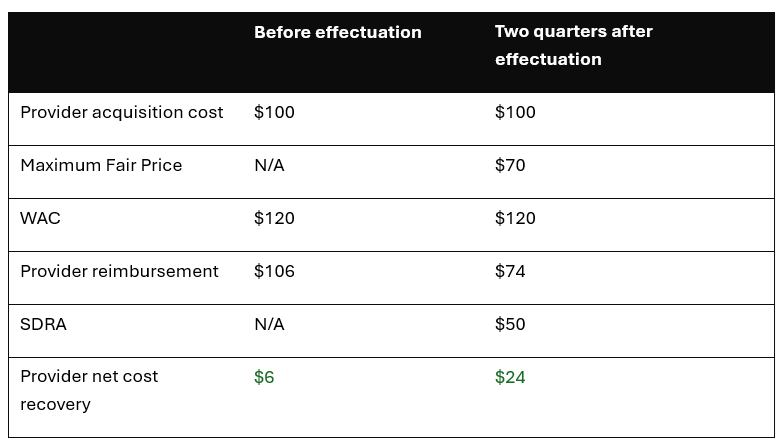
WAC-based SDRA options (Options 1a and 1b) could overestimate SDRA liability when acquisition costs are substantially lower than WAC. The potential for higher SDRA liability would be greatest for products with significant price concessions and discounts.
Consider the illustrative example below with selected Part B drug with a $70 MFP and an 80/20 Medicare and commercial volume split.
Table 1: Illustrative Example of Overestimation Risk Under Options 1a and 1b
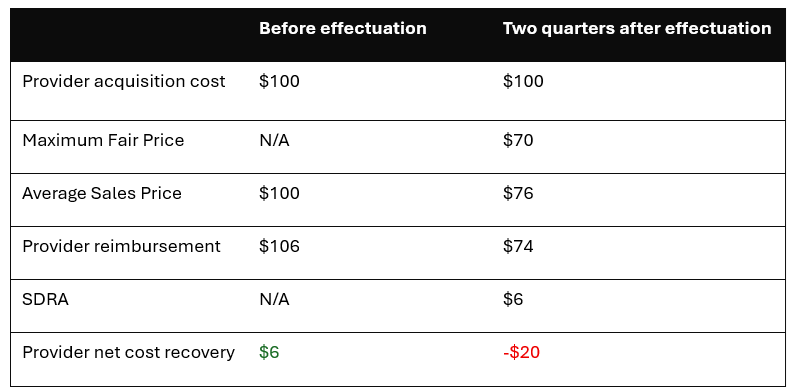
ASP-based SDRA options (Options 2a and 2b) could underestimate SDRA liability over time. The SDRA for the product would decrease as ASP decreases, meaning the SDRA may fail to capture the delta between acquisition cost and the MFP unless acquisition costs are adjusted in tandem, shifting incentives across stakeholders.
Table 2: Illustrative Example of Underestimation Risk Under Options 2a and 2b
Volume-Weighting Complexity vs. Provider Burden
ASP sales volume options (Options 1a and 2a) could introduce additional complexity and result in further MFP overestimations or underestimations for products with multiple NDCs at different prices and utilization patterns that substantially differ between payer markets. ASP data reflecting sales across all payer markets and CMS would be leveraged to calculate average per unit sales to establish a benchmark applied exclusively to Medicare. This could potentially result in the SDRA becoming misaligned with the average acquisition cost in Medicare.
Currently, providers are not required to report most NDCs in Medicare (although they are required to do so in commercial and Medicaid markets). If this were to be introduced to Medicare, it would be proposed via “appropriate rulemakings,” and any changes in calendar year 2028 rulemaking could result in abbreviated implementation periods ahead of IPAY 2028.
Graphic 2: Illustrative Example of Provider Burden Under Options 1b and 2b
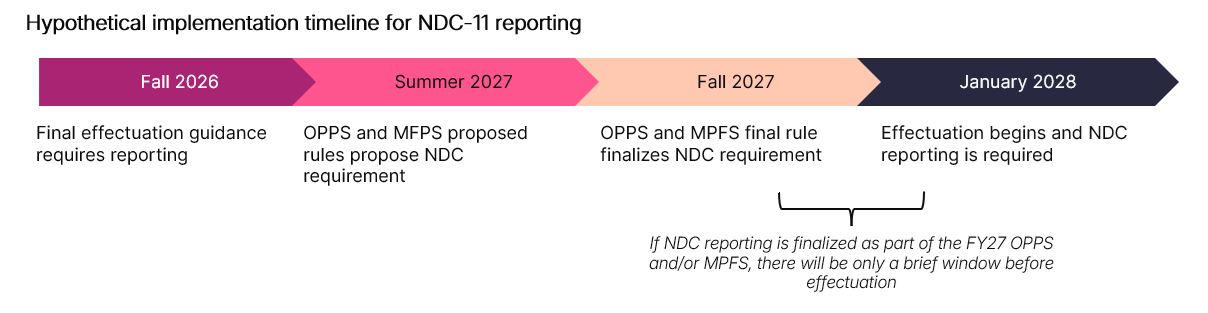
MPFS: Medicare Physician Fee Schedule; OPPS: Outpatient Prospective Payment System
Looking Ahead
Stakeholders should closely evaluate CMS’s proposed approaches for calculating the SDRA, considering the accuracy of MFP reconciliation amounts, potential provider burden, operational complexity, and downstream impacts on claims submission processes.
Comments on the draft guidance are due to CMS by 11:59 p.m. Pacific Time on September 18. CMS is expected to issue final guidance later in the year.
Connect with us to learn more about how Avalere Health supports client’s policy, access, pricing, contracting and channel strategy related to Part B negotiations.
Services
produces measurable results. Let's work together.