MFP Effectuation and the SDRA: The Possibility of ASP Spirals in Competitive Drug Classes

Summary
Efforts to manage negative provider cost recovery using ASP-based refunds risks acceleration of ASP erosion, creating tradeoffs across Medicare and commercial markets.Background
On July 16, the Centers for Medicare & Medicaid Services (CMS) released the Draft Guidance on Manufacturer Effectuation of the Maximum Fair Price (MFP) for Initial Price Applicability Year (IPAY) 2028 under the Medicare Drug Negotiation Program (MDNP). The guidance proposes policies governing how manufacturers of selected Part B drugs will effectuate (i.e., refund the difference between acquisition cost and the negotiated price) the MFP beginning in 2028.
In a previous Avalere Health Insight, the challenges facing products in classes where substantial provider discounts create a significant gap between wholesale acquisition cost (WAC) and Average Sales Price (ASP), which we referred to as competitive classes. We highlighted that under CMS’s WAC-based Standard Default Refund Amount (SDRA) methodologies, refund obligations could be overestimated because WAC does not reflect discounts in the market.
We also highlighted the opposite risk under CMS’s ASP-based SDRA methodologies in another Insight. ASP is based on historical pricing and may lag current provider acquisition costs; the resulting refund could be insufficient to fully reconcile a provider to the MFP. This could create negative provider net cost recovery (NCR), leaving providers financially underwater on the acquisition cost.
These publications highlight the central tradeoff in CMS’s proposed SDRA framework: WAC-based approaches may overestimate refunds while ASP-based approaches may underestimate refund amounts. These approaches introduce tradeoffs that challenge the ability to maintain sustainable provider economics over time.
Managing Provider NCR With a Gradual ASP Spiral
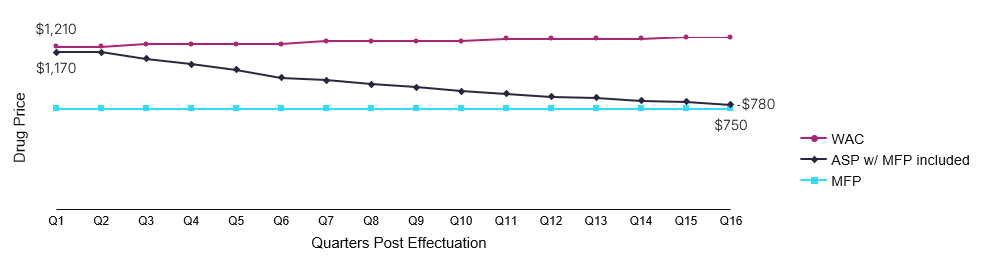
The possibility of a negative NCR assumes that existing contracting strategies and acquisition costs are maintained as ASP declines once MFP units are incorporated into the ASP calculation. However, contracting strategies could be adapted to reduce provider acquisition costs on a quarterly basis to preserve a positive NCR. These additional discounts would further reduce ASP, accelerating the closing of the gap between ASP and MFP over time. In effect, there could be a gradual ASP spiral, deliberately managing discounts to bring ASP closer to the MFP while reducing the risk of sustained provider losses. Below we have highlighted an illustrative example of a hypothetical ASP curve.
Table 1. Illustrative Part B Drug Pricing and Volume Assumptions

Figure 1. Illustrative example: ASP Curve with Four Years of MFP in Effect
Spillover of a Reduced ASP
While increased provider discounts could manage or eliminate the potential of negative NCR on Medicare volume, intentionally pushing ASP closer to MFP could create downstream effects beyond Medicare. As we will explore in a forthcoming Insight, a decreasing ASP may influence commercial reimbursement where contracts reference Medicare-based benchmarks, potentially extending the impact of the strategy into non-Medicare markets if the ASP was made public or could be deduced (e.g., using a combination of MFP-based payment limits and a public SDRA file). Additional discounts could also have implications for the Medicaid Drug Rebate Program and 340B pricing if they establish a new Medicaid best price, potentially increasing rebate liability and lowering the applicable 340B ceiling price. Alternatively, pricing actions, such as WAC increases, could potentially offset ASP pressure. However, the ability of pricing actions to limit an ASP spiral would depend on inflation rebate exposure, payer mix, and whether commercial pricing gains are large enough to offset declining ASP.
ASP Spiral Risks Could Shift Incentives
Alternative effectuation strategies could be explored if CMS selects an ASP-based SDRA methodology. One option is to use a WAC-based refund methodology, which would increase provider payment and reduce the risk of a negative NCR. However, this would result in higher manufacturer liability.
Another possibility is prospective effectuation, under which providers acquire MFP-eligible units at or near MFP rather than receiving a refund after services are provided. The key operational question for a prospective approach is whether MFP-priced inventory can be reliably limited to Medicare-eligible utilization and whether there would be diversion to non-MFP-eligible patients.
Certain therapies could also be evaluated for access through the pharmacy benefit rather than the medical benefit, potentially changing the effectuation and provider economic dynamics altogether. The feasibility of this approach would depend on the product, distribution model, and benefit design, with a key question being how Part D plans would cover and manage therapies that have historically been administered under Part B.
The most likely market response remains uncertain, with each effectuation pathway introducing its own set of financial and operational tradeoffs. Stay tuned for our next analysis on how MFP effectuation decisions could affect commercial reimbursement and contracting.
Interested in learning more? Connect with us to understand how Avalere Health supports client’s policy, access, pricing, contracting and channel strategy related to Part B negotiations.
Services
produces measurable results. Let's work together.