Effectuation and SDRA: The Dilemma of Competitive Drug Classes

Summary
CMS’s proposed SDRA methodologies for IPAY 2018 of the MDPNP could result in materially different refund obligations across products based on their competitive and discount profiles.On July 16, the Centers for Medicare & Medicaid Services (CMS) released the Draft Guidance on Manufacturer Effectuation of the Maximum Fair Price (MFP) for Initial Price Applicability Year (IPAY) 2028 under the Medicare Drug Negotiation Program (MDNP). The guidance proposes policies governing how manufacturers of selected Part B and Part D drugs will effectuate the MFP beginning in 2028, including the methodologies available to reconcile payment under a retrospective effectuation model.
In a previous Avalere Health Insight, we examined the tradeoffs between prospective and retrospective MFP effectuation models and evaluated the four Standardized Default Refund Amount (SDRA) methodologies proposed by CMS. The SDRA is a CMS-calculated standardized default refund amount that serves as a proxy for the difference between a provider’s acquisition cost and the MFP when the actual acquisition cost is not available. The Insight describes how wholesale acquisition cost (WAC)-based SDRA methodologies could overestimate manufacturers’ refund liability by failing to account for provider acquisition discounts, while Average Sales Price (ASP)-based methodologies could underestimate manufacturers’ liability over time, as ASP reflects historical pricing and lags current market dynamics.
As manufacturers consider effectuation options, understanding a product’s historic contracting strategy and erosion will be critical (note: for the purposes of this Insight, “contracting” and “discounts” refer to price concessions included in ASP calculations). For example, two products with the same WAC but different contracting strategies, one product with minimal contracting and thus a similar WAC and ASP, and another product with substantial contracting where ASP is much less than WAC, will produce very different refund obligations. As a result, the same SDRA methodology may affect stakeholders differently depending on the competitive environment and pricing dynamics.
Provider discounts shape the WAC-to-ASP relationship
WAC represents a product’s published list price and does not reflect discounts or other price concessions provided throughout the distribution channel. ASP, by contrast, incorporates certain discounts and rebates reported by manufacturers.
The difference between WAC and ASP varies considerably across products, reflecting complex relationships between manufacturers, payers, providers, distributors, and other stakeholders whose roles often vary across therapeutic areas and drugs classes. Consequently, the financial impact of a WAC- vs. ASP-based SDRA methodology depends largely on a product’s historical discounts.
Avalere Health developed an illustrative comparison to demonstrate how product and contracting strategies can shape liability under the proposed SDRA methodologies.
Illustrative example: Both products have a WAC of $100 and MFP of $60. The total Medicare volume for both product is 500,000 billing units.
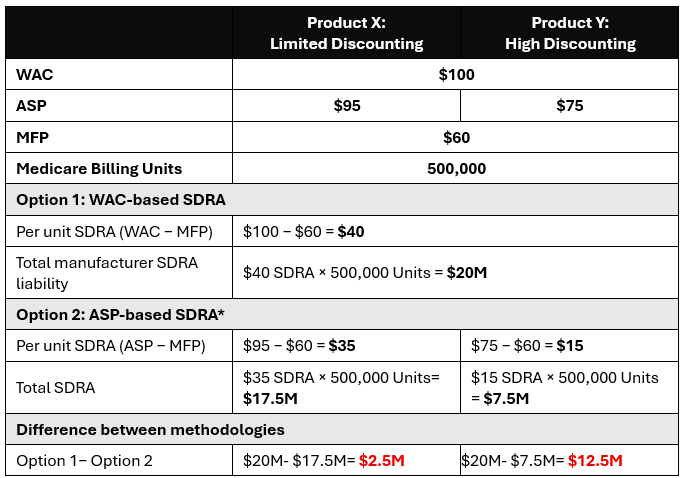
* Assumes a constant ASP throughout the year, which under certain market conditions could result in negative provider net cost recovery.
Under these assumptions, a WAC-based methodology is 14% greater for Product X compared with an ASP-based methodology, but 167% greater for Product Y. The difference in liability between these scenarios reflects the greater contracting for Product Y than Product X.
Implications
The proposed Part B SDRA methodologies underscore that the negotiation impact for manufacturers will not only depend on the negotiated MFP, but also the refund methodology under a retrospective model. Manufacturers of heavily discounted products will need to carefully evaluate effectuation plans, as WAC-based SDRA methodologies may significantly overestimate acquisition costs, while ASP-based methodologies may fail to fully reimburse providers for acquisition costs, as we discussed in our prior Insight. In contrast, manufacturers of products with less price concessions may experience relatively smaller difference in liability between WAC- and ASP-based methodologies because the gap between WAC and ASP is smaller.
When these per-unit differences are applied across the Medicare market and multiple years of MFP applicability, the SDRA methodology selected by CMS could result in billions of dollars in differential liability obligations.
Payer mix may further amplify or mitigate these effects by shaping how strongly Medicare pricing benchmarks spill over into commercial reimbursement and contracting. Stakeholders may need to consider how the selection of an acquisition cost proxy between ASP vs. WAC could shift incentives that extend beyond Medicare. A forthcoming Avalere Health analysis will explore potential commercial spillover impacts.
Interested in learning more? Connect with us to understand how Avalere Health supports client’s policy, access, pricing, contracting and channel strategy related to Part B negotiations.
Services
produces measurable results. Let's work together.