

CMS Recognized Greater Savings in IPAY 2027 Relative to the First Year of Negotiation

Summary
Competitive dynamics of selected drugs in 2027 drove greater savings than 2026.Background
On November 25, the Centers for Medicare and Medicaid Services (CMS) released the Maximum Fair Prices (MFPs) for the 15 Part D drugs selected for Medicare drug price negotiation. The negotiated prices will go into effect on January 1, 2027.
A CMS fact sheet released the same day contains details on the MFPs, 2024 list prices, estimated savings to Medicare and beneficiaries, and information about how the negotiation process unfolded for the second round of negotiations. CMS’s detailed rationale for each negotiated MFP is not expected until Spring 2026, but manufacturers can draw key insights now from this MFP release.
The negotiation process for Initial Price Applicability Year (IPAY) 2027 was meaningfully different from IPAY 2026: It was the first year of negotiation with the Trump administration and it incorporated learnings from the first round of negotiation, including technical changes to the calculation of the net price of therapeutic alternatives.
Actionable Takeaways
The release of the IPAY 2027 MFPs provides valuable insight into the negotiation process, offering both learnings and highlighting trends that may inform how manufacturers approach future IPAYs.
Avalere Health has identified three initial key takeaways for stakeholders:
1. Competitive Market Dynamics Shaped MFP Discounts from Net Price
Across both IPAY 2026 and 2027, modeled MFP discounts deepen as products move from less competitive to highly competitive and heavily rebated classes:
- Highly competitive classes already show substantial net Part D discounts relative to gross prices. Their MFPs often sit only modestly below current net prices, with additional incremental discounts. MFPs for these drugs frequently cluster near the level of existing net-to-gross rebates, although there is variation within competitive products. This variation is likely driven by clinical value factors and comparative effectiveness relative to therapeutic alternatives included in Information Collection Request submission and differences in approaches to CMS meetings as part of the negotiation process.
- Products facing less competitive downward pricing pressure pre-Inflation Reduction Act (IRA) start from much higher net prices relative to gross prices. MFPs sit much further below existing net Part D prices, often representing a shift from minimal or no net rebates to sizeable price concessions.
2. MFP Discounts are Greater in IPAY 2027 than IPAY 2026
- In IPAY 2026, many high-volume drugs had MFP discounts that were close to existing net Part D levels, with only modest incremental reductions. A few specialty products with relatively modest pre-negotiation rebates had more substantial downward shifts, but they represent a minority of total spend.
- In IPAY 2027, MFPs tend to sit further below current net prices across a broader set of products. Several products display gaps between net price and MFP that are larger than estimates from the first year.
3. Compounding Factors Drove Higher CMS Savings for IPAY 2027 Compared to IPAY 2026
- For most IPAY 2026 drugs, CMS liability ultimately will increase once MFPs are effectuated since once an MFP is in effect, manufacturers of selected drugs are no longer required pay the 10% and 20% discounts in the initial and catastrophic phases to CMS. Instead, CMS takes on this liability in addition to the lower patient OOP cap implemented as part of Part D Redesign. When MFPs are higher than net costs, the increase is reflected in plan bids.
- For IPAY 2027, CMS made a technical change to its starting point calculation methodology to include Coverage Gap Discount Program payments. However, CMS did not apply this change to the calculation of selected drug net Part D prices. In some cases, this dynamic increases the delta between the starting point and ceiling price in the negotiation process.
- As indicated above, the competitive dynamics of selected drugs meaningfully shaped the level of discount from net price. Compared to IPAY 2026, in IPAY 2027 there were a greater number of products with minimal rebating and less competitive dynamics, increasing the discount from the statutory ceiling overall.
Avalere Health built an actuarial model to identify which product types are driving CMS savings. Based on these dynamics, majority of savings are recognized for products in less competitive classes.
Figure 1. Estimated Net CMS Cost/Savings by Competitive Dynamics
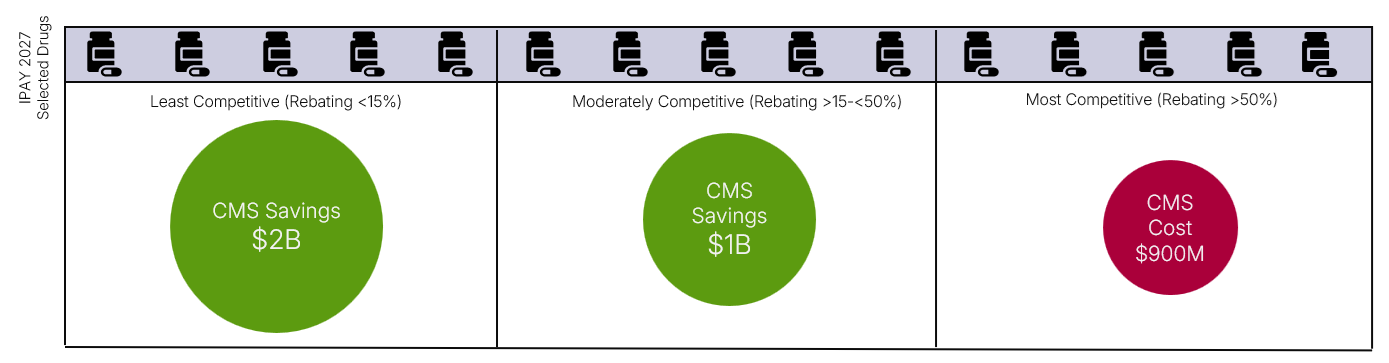 Analysis Notes: To conduct this analysis, Avalere Health estimated the 30-day equivalent supply for each selected product and sized that relative to the difference between the MFP and breakeven point. Avalere Health uses point estimates in its analysis; however, insights should be considered directional.
Strategic Implications of These Year-over-Year Dynamics
For manufacturers, IPAY 2026 negotiation seemed to be more like a compression of existing rebate spreads in very competitive markets, whereas IPAY 2027 introduced greater risk of step-change price reductions due to several driving factors, including product mix, guidance changes, and implementation of negotiation.
While the IPAY 2028 negotiations will follow the process set out by the first two years of the Medicare Drug Price Negotiation Program (MDPNP), it will be the first year that Medicare Part B products will also be eligible for negotiation. Selection of Part B products introduces new complexity in the calculation of key negotiation price metrics and will be critical to consider relative to broader negotiation learnings.
As more products are selected for the MDPNP, impacts will continue to shift as comparators are negotiated and their MFPs are used to calculate the starting point.
A Trusted Partner for IRA Negotiations
An effective IRA negotiation preparation and response strategy requires informed analysis and ability to connect the dots across the drug pricing landscape Avalere Health’s dedicated IRA team supports manufacturers in understanding the nuance and complexities of MFPs and interactions between the various IRA drug pricing provisions.
To learn more about the impact of Medicare drug price negotiation and the components of an effective preparation strategy, connect with an Avalere Health expert today.
Services
produces measurable results. Let's work together.


