2026 Dyslipidemia Guideline Signals a New Standard for Cardiovascular Risk Management

Summary
A jointly published guideline on dyslipidemia (i.e., unhealthy presence of lipids in the blood) emphasizes proactive lifetime CVD risk reduction, with important implications for patients, providers, and payers, as well as quality measurement.The 2026 Playbook: Screening Smarter, Treating Earlier, and Measuring What Matters
Earlier this year, the American College of Cardiology (ACC), American Heart Association (AHA), and nine other associations see Appendix) jointly released the 2026 Guideline on the Management of Dyslipidemia, replacing the 2018 guideline. The 2026 clinical practice guideline (CPG) addresses the evaluation, management, and monitoring of individuals with dyslipidemias. Unlike the 2018 version, which heavily emphasized high blood cholesterol, the 2026 update encompasses a broader evidence base with new treatment targets, treatment options, earlier intervention, and personalized risk assessment for cholesterol, hypertriglyceridemia, and elevated lipoprotein(a) (Lp(a)). Key recommendations include the identification and treatment of cardiovascular disease (CVD) with tailored recommendations for pediatric, elderly, female, and other vulnerable populations.
What do the new guidelines mean for stakeholders?
The new guideline indicates a shift towards earlier, more personalized, and more intensive prevention with downstream implications for coverage policy, diagnostics, quality measurement, and therapeutic innovation (see Figure 1). Screening recommendations for children (ages 9–11) and young adults expand the total addressable market for lipid-lowering medications and reinforces a national focus on primary prevention.
Figure 1. Key Updates in the 2026 Guideline on the Management of Dyslipidemia
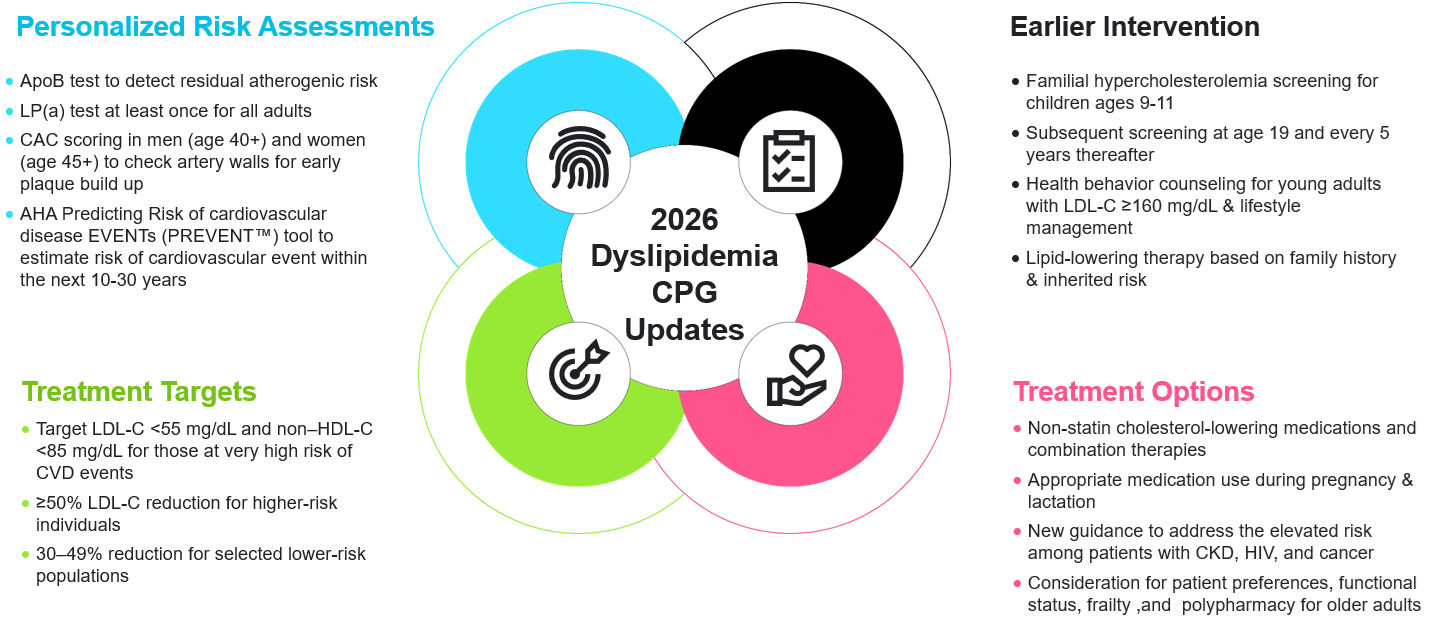
ApoB: Apolipoprotein B; CAC: Coronary Artery Calcium Scan; CKD: Chronic Kidney Disease; HIV: Human Immunodeficiency Virus
Payers will face pressure to modernize coverage policies to facilitate the widespread adoption of ApoB and Lp(a) testing and CAC imaging, trading upfront laboratory costs to offset more expensive CVD events and complications later in life. Although statins have been a mainstay of cholesterol management for years, the influx of new (and pipeline) targeted therapies, such as triglyceride-lowering therapies, offers clinicians a more comprehensive toolbox to lower and/or address lifetime risk of CVD.
Currently, quality programs like HEDIS and Medicare Advantage (MA) Stars assess cholesterol management based on utilization and adherence to statin therapy. With the advent of new therapies, coupled with numeric LDL targets, stakeholders should monitor how the National Committee for Quality Assurance (NCQA) and the MA Stars program respond and adapt their approach for defining quality of care for these patients.
For example, NCQA and others may consider pivoting towards LDL-outcomes measures, following AHA’s lead. CMS has proposed a new AHA-developed quality measure for inclusion in the Merit-Based Incentive Program (MIPS) called Low Density Lipoprotein Cholesterol (LDL-C) Monitoring and Management, which assesses whether patients had an LDL test and if their LDL levels were at target.
A Proactive Approach
The 2026 guideline represents a shift from reactive cholesterol management to proactive lifetime cardiovascular risk reduction. Compared with the 2018 guideline, it broadens the eligible treatment population, introduces more personalized risk assessment (PREVENT, CAC, ApoB, Lp(a)), reinstates LDL-C treatment goals, and encourages earlier and more intensive intervention. Together, these changes have the potential to reshape the quality and policy landscape for lipid-lowering therapies over the coming decade; however, the success and speed with which the new guidelines are adopted will depend on provider readiness.
Collectively, the CPG recommendations are predicated upon multidisciplinary lipid management, which will require coordination among cardiologists, gerontologists, and primary care providers who will need to update clinical workflows and electronic health records to leverage the new risk assessment tools.
To learn more about the recent dyslipidemia updates and how evidence generated today will lay the foundation for future CVD guidelines, connect with us.
Appendix
The anticipated influence of this CPG is high, given the broad endorsement from following associations:
ACC – American College of Cardiology
AHA – American Heart Association
AACVPR – American Association of Cardiovascular and Pulmonary Rehabilitation
ABC – Association of Black Cardiologists
ACPM – American College of Preventive Medicine
ADA – American Diabetes Association
AGS – American Geriatrics Society
APhA – American Pharmacists Association
ASPC – American Society for Preventive Cardiology
NLA – National Lipid Association
PCNA – Preventive Cardiovascular Nurses Association
Services
produces measurable results. Let's work together.